RWA (Real-World Asset)
Tokenization: Why Institutions Are Paying Attention
The Institutional Shift Toward Tokenized Assets
Over the past few years, blockchain discussions have been dominated by cryptocurrencies and speculative digital assets. But now we see the focus has shifted; the focus is now on something much more significant: integrating actual financial assets into blockchain networks.
From commodities and private credit to government bonds and real estate, massive amounts of real-world value are managed by international financial systems. Yet a large portion of this infrastructure still depends on multiple intermediaries, inefficient settlement processes, and fragmented databases that were never designed to work together seamlessly.
The question is no longer whether tokenized assets will reshape financial systems. It's about how quickly organizations will adapt — and whether they'll lead or follow the transformation.
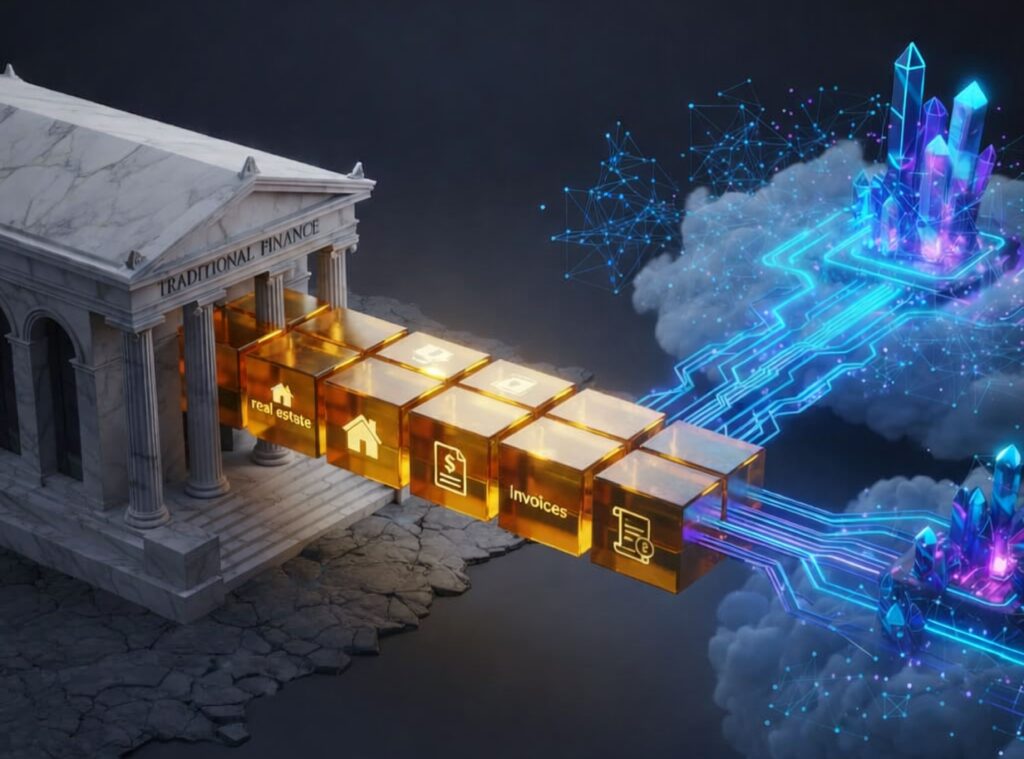
This is where real-world asset tokenization enters the conversation. By representing traditional assets as blockchain-based tokens, organizations can unlock new liquidity, improve transparency, and enable global participation in previously inaccessible markets.
What Are Real-World Assets (RWAs) in Blockchain?
Imagine being able to invest in a building, a government bond, or gold without having to purchase the entire asset outright. Real-World Assets (RWAs) make this possible. They are traditional or tangible financial assets transformed into digital tokens on a blockchain — a process known as asset tokenization.
Each token represents a fractional share of the underlying asset and can be purchased, sold, or transferred digitally. A $10 million commercial property, for example, can be divided into thousands of tokens — allowing investors to own small sections of it without acquiring the whole. In the same way, bonds and commodities like gold can be tokenized to simplify international trading and access.
Real Estate
Property ownership can be divided into digital shares, enabling fractional investment in commercial or residential buildings at any scale.
Government Bonds
Treasury instruments can be issued as blockchain tokens, dramatically improving settlement efficiency and reducing counterparty risk.
Commodities
Tangible assets like gold, oil, and agricultural products become digital tokens — enabling faster, more efficient global trading with transparent ownership records.
Private Credit
Institutional lending markets are using tokenization to automate loan contracts on-chain, improving liquidity and reducing administrative overhead in private debt markets.
The key distinction: Unlike standard digital records, digital asset tokenization ensures that ownership information is both publicly accessible and cryptographically validated — creating an immutable, verifiable record that no single party can alter unilaterally.
How Does Real-World Asset Tokenization Work?
Understanding the technical and operational bridge between physical assets and blockchain is essential to grasping the full potential of RWA tokenization. The process begins with selecting a real-world asset and defining ownership through a compliant legal framework — then issuing digital tokens and enabling them to trade in open markets.
Legal validity is non-negotiable: Platforms designed for RWA tokenization combine financial compliance processes with blockchain infrastructure to ensure the asset's ownership and rights remain protected by standard legal frameworks — even as it exists digitally on a distributed ledger.
Why Are Institutions Paying Attention?
The answer lies in structural inefficiencies within traditional financial markets. Settlement delays, liquidity constraints, geographic barriers, and opacity in ownership records are not minor friction points — they represent billions in trapped capital and operational overhead that tokenization can directly address.
Tokenization divides traditionally illiquid assets — like real estate — into smaller digital shares, boosting market liquidity and enabling broader investor participation globally.
Traditional financial processes typically require days to clear. Blockchain-based systems enable far faster settlement — often near-instant — at significantly lower operational cost.
Tokenized markets allow cross-border participation without complex intermediary networks — opening institutional-grade assets to a genuinely global investor base.
Blockchain ledgers create a single verifiable record of asset ownership — replacing fragmented databases with an immutable, auditable source of truth accessible to all participants.
According to the World Economic Forum: tokenization could unlock trillions of dollars in currently illiquid global assets — representing one of the largest potential capital efficiency gains in the history of modern financial infrastructure.
Key Institutional Use Cases of Tokenized Assets
Real-world implementation of tokenized assets is already emerging across several financial sectors. Enterprise leaders are deploying applications that meaningfully enhance capital efficiency and asset accessibility — not as experiments, but as production-grade financial infrastructure.
Technology Stack Behind RWA Platforms
Successful RWA tokenization depends on a robust technology infrastructure that combines blockchain protocols with enterprise compliance systems. No single component is sufficient on its own — the value emerges from how these layers interact.
Automate ownership transfers, profit distribution, and compliance rule enforcement without intermediaries.
Standardized blockchain tokens ensure cross-platform compatibility and interoperability across financial systems.
Secure institutional custody solutions protect the underlying physical or financial assets linked to each digital token.
External data feeds connect real-world asset information — valuations, yields, events — directly with on-chain systems.
KYC and AML frameworks ensure institutional participants meet regulatory obligations across every applicable jurisdiction.
The distributed ledger layer that provides the immutable, transparent record of ownership — the foundation every other component builds on.
Technology alone is not sufficient. For RWA tokenization to work at scale globally, institutions also need regulatory clarity, trusted custody frameworks, and financial systems capable of interoperating across borders. The technology stack is ready — the infrastructure ecosystem is still maturing.
Risks and Limitations of RWA Tokenization
Despite its potential, RWA tokenization still faces several structural challenges. Understanding these limitations is just as important as understanding the benefits — because institutions cannot deploy this infrastructure at scale without directly addressing them.
Consider a bank wanting to tokenize a $50 million commercial property. Even if the blockchain platform functions perfectly, the bank still needs to ensure digital tokens legally prove ownership. Without regulatory clarity or strong custody frameworks, institutional confidence collapses — regardless of how elegant the technology is.
The path forward is clear: As legal ownership frameworks, regulatory clarity, and system integration barriers are gradually resolved, RWA tokenization moves from experimental projects to a reliable foundation for global digital asset markets. Building trust with major financial institutions requires methodically solving each of these challenges — not racing past them.
Future Outlook of Institutional RWA Markets
What happens when trillions of dollars in traditional assets begin migrating toward distributed ledger systems? Financial markets become more open, transparent, and efficient — at a speed and scale that centralized intermediaries simply cannot match. That is the trajectory the industry is now on.
The growth of institutional RWA markets will largely depend on how financial institutions adopt blockchain infrastructure over the next five years. Several trends are already converging to accelerate this transition.
Bonds, funds, and securities may increasingly exist as blockchain-based instruments as digital issuance becomes the regulatory default.
Regulated financial institutions are beginning to integrate decentralized finance infrastructure into compliant asset management workflows.
Global financial systems may adopt blockchain settlement rails as the shared infrastructure layer for cross-border asset transactions.
According to McKinsey & Company: tokenized securities could become a significant component of digital financial markets within the next decade. The organizations exploring and building around tokenized assets now are positioning themselves to define the infrastructure standards that late movers will be forced to adopt.
Conclusion
The emergence of real-world asset tokenization signals a fundamental evolution within the world's financial systems. Institutions are now seriously investigating how tokenized assets can improve liquidity, transparency, and operational efficiency — not as a speculative bet, but as a structural upgrade to infrastructure that has remained largely unchanged for decades.
The long-term trend toward tokenization is gaining momentum despite current infrastructure, integration, and regulatory barriers. The data and the institutional momentum both point in the same direction — the question is execution speed, not direction.
For financial institutions and Web3 founders alike, the pivotal question has evolved. It's no longer whether tokenized assets will reshape financial systems. It's whether your organization will help build the new standard — or inherit the one someone else designed.
The early movers who begin investigating and building around real-world asset tokenization today could very well be the ones steering the next wave of digital financial infrastructure. The window for that positioning is open now — and it will not remain open indefinitely.